Why Shreddage 3 Electro Sitar Is the Psychedelic Era in a Kontakt Patch
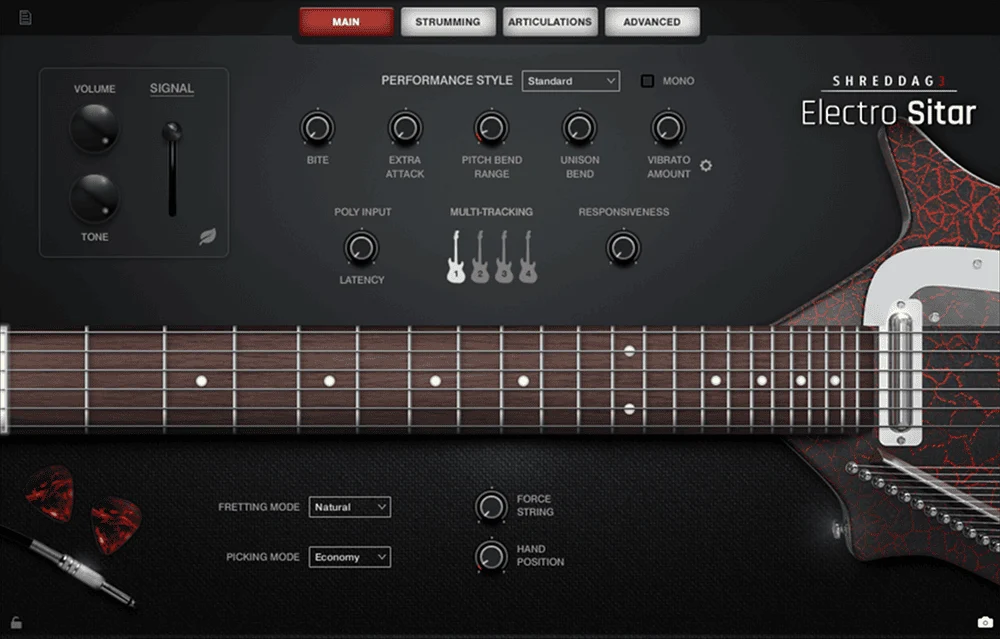
Shreddage 3 Electro Sitar. A sampled Danelectro electric sitar, buzz bridge and all, in Kontakt. The psychedelic era on tap.
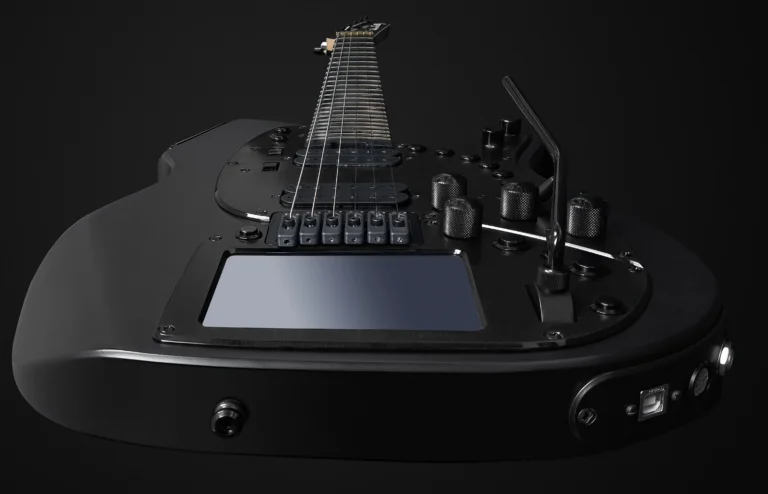
In the 1960s, British and American musicians fell in love with the Indian sitar but not with the years of study the instrument demands. George Harrison’s work with Ravi Shankar made the sound fashionable, and fashion moves considerably faster than discipline. The Danelectro electric sitar, developed with session guitarist Vinnie Bell around 1967, was the compromise. A guitar-shaped instrument with a buzzing bridge that approximated the sitar’s shimmer without requiring anyone to learn actual sitar. It defined a specific sound, the psychedelic-era Western sitar, and Shreddage 3 Electro Sitar samples it with real care.
The instrument is worth understanding on its own terms. The Danelectro’s buzz comes from a flat bridge, sometimes called a buzz bridge, which lets the strings vibrate against it in a controlled rattle. That rattle is a crude approximation of what the sitar’s curved jawari bridge does, and any sitar player will tell you the two are not the same thing. But it is a genuinely distinct sound rather than a bad imitation, and it turned up on enough records between 1967 and 1974 that it became its own signifier.
Released by Impact Soundworks, the library captures a Danelectro with the detail the Shreddage engine is known for. It is honestly a narrow instrument, but within that narrow lane it is close to definitive.
Advantages
The buzz bridge tone is captured with remarkable fidelity. The characteristic shimmer, the metallic sustain, the drone strings, all of it is there. Sampling a buzzing bridge is technically awkward because the buzz is chaotic rather than periodic, and the library handles the variation without falling into the machine-gun repetition that plagues cheaper sample sets.
The Shreddage 3 engine gives deep control over articulation and voicing, including the strumming and chord-detection features that make the Shreddage line usable by people who cannot play guitar parts on a keyboard. For the specific sound it targets, this is basically the reference library.
Disadvantages
The instrument is specific. It sounds like an electric sitar, which means it sounds like the 1960s, and there is no way to make it sound like much else. Producers hoping for a versatile fusion tool will find it a one-flavour library.
There is also a cultural point worth making. This is not a sitar library. It samples a Western approximation of a sitar, built for musicians who wanted the sound without the study, and anyone looking for authentic Hindustani classical tone should be shopping elsewhere entirely. The library does not pretend otherwise, which is to its credit. It does one era brilliantly and makes no claim on any other. That honesty is rarer in sample libraries than it should be.
Use Cases
Retro and vintage production: any track referencing 1960s or 1970s rock, soul, R&B, or Motown benefits instantly.
Psychedelic and neo-psych: the drone and buzz sit perfectly in modern psych productions, where the reference is understood rather than accidental.
Film and television scoring: an immediate sonic shorthand for the era, useful whenever a scene needs to signal the period without a word of dialogue. Three notes and the audience knows it is 1968.
Why Shreddage 3 Electro Sitar Is Harder to Sample Than It Looks
The buzz is the entire instrument and it is also the reason this library is a technical achievement rather than a routine capture. A conventional guitar bridge terminates the string at a single point, producing a periodic waveform a sampler can loop cleanly. The Danelectro’s flat bridge lets the string make and break contact with the bridge surface across the decay, which generates a chaotic, non-periodic component that changes with pick attack, string age, and humidity. Loop that naively and the buzz becomes a machine-gun stutter within two seconds. The library avoids it, which means either substantially longer capture times per note or round-robin depth well beyond what a narrow instrument would normally justify. For a library serving one era, that is an unusual amount of care to spend on a detail most buyers will never consciously notice, and it is the reason the library holds up against a real Danelectro rather than merely gesturing at one.
Check out the product here: Shreddage 3 Electro Sitar