Why I Chose to Be Nobody | Social Treble and The Analog Ghost
Why did I start Social Treble as The Analog Ghost? A look at the decision to leave an old name behind, and the music and stories made possible by it.
In a March 2026 interview, the first question about music-making I faced, went somewhere unexpected. Before answering when I first picked up an instrument, I explained why the names attached to earlier work would remain unnamed. Only then did a harmonica appear in the picture. It was my sixth-birthday gift from my father. There is an ordinary childhood memory at the end of that detour, but it takes a little while to arrive, and the delay matters to an artist who has chosen what a listener gets to know before pressing play.
A familiar name could have brought existing listeners, context and recognition into the new work. Social Treble could have been introduced as another chapter in an established career. The earlier catalogue was real and the decision to set that introduction aside was my deliberate choice. But why? It is simply because I believe that this work should be encountered without positive or negative bias carried across from older projects. The decision does not establish that past recognition is harmful or that biographies have no value. It does establish that I, as the artist, did not want an inherited account of my work to replace a new encounter. That seems a rather reasonable boundary.
There is a temptation to turn such a choice into an instruction for everyone else. Stop reading biographies, perhaps or, maybe, give unknown music a certain number of minutes before forming an opinion. Either instruction would be actually quite tiresome. Listeners have perfectly good reasons to follow artists they love, and a great biography can deepen an encounter with a record. The interesting question is narrower: why did Social Treble need an introduction that began without a familiar history? The answer becomes clearer when my whole operation’s actual purpose enters the discussion.
A boundary is not a costume
The Analog Ghost can sound like a costume, especially when read beside the words faceless channel. One can imagine a whole theatre of secrecy built around the decision, complete with a hood that obligingly catches the light. But it is nothing a structural necessity, not an alter ego. The identity marks a limit on what the public account must provide, while allowing the work to be published, credited and questioned. It is not an invitation to look behind that limit for the missing plot twist. Some mysteries are interesting because somebody made them; other things are simply not public material.
That distinction also protects the art from being mistaken for a factual deposition. I have previously described Social Treble’s fictional situations as reworkings of lived experience. The future setting is an artistic transformation, not evidence that a particular invented event happened as shown. A listener can recognize something true about ordinary life without demanding a one-to-one key to every character. Fiction has always had that ability, though it is rather strange that an artist should need to explain it when the costume is digital rather than made of cloth.
The public binaural-production e-book contains plugin screenshots, source-position diagrams and explanations of what the separate stages do. A reader can inspect how instruments were placed and treated, while leaving private circumstances where they belong. One sort of information helps evaluate the work; another can turn it into a hunt for the maker. They are not equally owed, though the internet has a habit of treating every unfilled box as a challenge.
And yet the identity is not the whole reason Social Treble exists. What sort of project would require music, image and narrative to be conceived together, rather than one added at the end as a promotional extra? It is because the experiences are too dense for a conventional verse-and-chorus format, and the intention to make immersive audiovisual work based on those experiences takes the priority. The story needed a score. It also needed enough time and visual space for the listener to inhabit what the words alone might reduce to an explanation. That is where the channel’s creative purpose becomes more interesting than the name on the profile.
What the music required
There is an early clue to how my thinking developed, and it isn’t a computer or a recording studio. Rather, it was a gift from my father on my sixth birthday. I remember opening a harmonica that day and trying to make sounds immediately. Indian classical recordings and old Hindi film songs at were almost always a staple at home during my childhood. The harmonica parts from old Hindi Film songs were the ones that especially caught my attention. I might have been able to play the instrumental, in a musical sense, that afternoon. But I really wanted to find out what the instrument could do.
A few years later, Pink Floyd’s The Dark Side of the Moon supplied a different discovery. As a nine-year-old encountering my first Western album, I could not account for everything I was hearing, but the experience changed the way he thought about what music could carry. I remember seeing Porcupine Tree at IIT Mumbai’s Mood Indigo in 2009, the first time I listened to the band live. That concert is not the cause of Social Treble, and it need not be made into one. But Porcupine Tree was the band (Steven Wilson was the particular musician) that truly shaped musical curiosity and the way I think about sound even today.
I should admit here that I have described myself as a “relative synthesist”, and this phrase helps explain why Social Treble crosses forms without treating any one of them as sacred. It is about practically choosing which skills to tools to use to solve particular problem requires. A piece may begin as music and discovering it might require a story or an image, and the sound and visual may then change together as the work develops. That does not make every software setting a revelation. It means the artistic decision remains in charge of the equipment rather than the other way around. The music still has to work when the explanation is taken away.
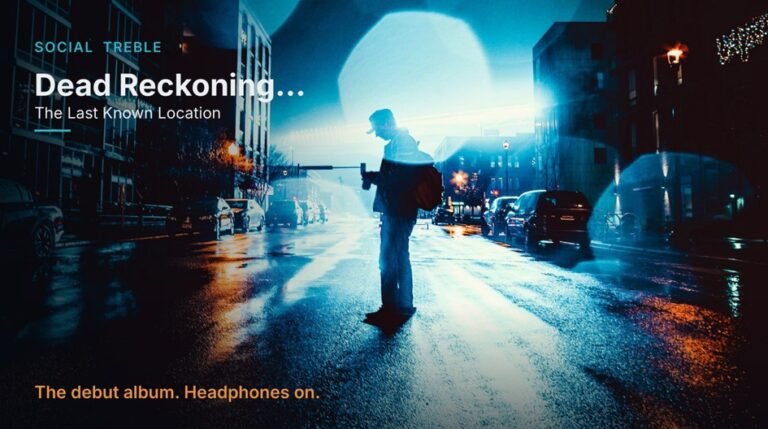
The released debut album, Dead Reckoning… The Last Known Location, offers one example of the result. Its album narrative and listening experience are already available, and the separate album Transmission examines the fictional story in detail. Retelling the plot here would defeat the purpose of referring to it. The album demonstrates what happens when the sonic and visual decisions are developed as one piece of storytelling. The identity question, meanwhile, remains larger than a single release.
An artist can control the work’s construction without controlling the audience’s response. I was once asked in an interview about what people should take away from my music and I had simply declined to choose for any listener. Why? Because one listener may follow the story, another the sound, and another may decide the piece is not for them. That is fine because the work offers an experience, not a compulsory conclusion. It is better that way.
The work that remains answerable
At this point the word “nobody” could become an unhelpful slogan. A person does not stop having a history simply because an earlier artistic name is absent from the introduction. Nor does privacy remove the obligation to stand behind work that has been put in public. Social Treble credits its releases and explains methods where those methods are relevant, while leaving the private life out of the performance. That is a more exact description than disappearance. Being answerable for the work does not require a grand reveal, does it?
The practical independence matters because it is visible in the work itself. I build the music and visuals alone, using skills acquired over time so that decisions can carry across each stage of production. The same person can return to a mix after seeing what a scene needs, or change a visual choice after hearing the music again. For me, that is the actual choice. That being said, no one is obliged to make art this way. In fact, some of the most remarkable recordings in history have depended on collaboration, and this argument does not demote them. Here, independence is the working condition chosen for this particular kind of output.
There is a quiet sort of persistence in that arrangement though. A listener or viewer sees the finished film or listens to the finished album, not the number of times the maker went back to change a scene or move a sound. The record of those corrections belongs in the work, where each change either helped or did not. It is not evidence of a moral victory, and there is no need to invent a dramatic turning point to make it inspiring. What can be observed is the work itself, published and available to examine. Sometimes that is enough.
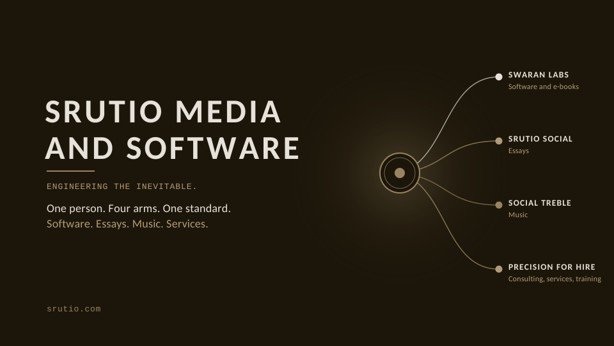
Srutio Social’s essays and Swaran Labs’ technical material appear only where they offer a useful continuation of this story. An article can analyze what a film makes someone feel; a free production guide can show how a spatial mix was built. They are related practices, but the artistic subject here remains Social Treble. Anyone who wants to know more can follow the relevant links without being asked to absorb an organization chart first.
So, what is the takeaway here? The answer is that there is none whatsoever. Perhaps that is enough of an introduction.
Sources For Further Reading
- Plastic Magazine | INTERVIEW: Cinematic music video from Social Treble: https://plasticmag.co.uk/2026/03/interview-cinematic-music-video-from-social-treble/
- Dulaxi | Exclusive Interview With Social Treble, Crowded Silence: https://dulaxi.com/exclusive-interview-with-social-treble-crowded-silence-binaural-audio/
- The Interviewist | Social Treble: https://www.theinterviewist.com/2026/05/08/social-treble/
- Punk Head | Social Treble Turns Corporate Dread Into Futuristic Cinema on “Crowded Silence”: https://www.thepunkhead.com/music/social-treble-turns-corporate-dread-into-futuristic-cinema-on-crowded-silence
- Srutio Social | What Is Srutio Social?: https://srutiosocial.com/what-is-srutio-social/
- Srutio Social | Dead Reckoning… album Transmission: https://srutiosocial.com/binaural-audio-album-dead-reckoning-social-treble/
- Swaran Labs | How To Produce Binaural Audio Effectively: https://swaranlabs.com/product/how-to-produce-binaural-audio-effectively/
- Social Treble | Full album narration and listening film: https://www.youtube.com/watch?v=FlMoKN1cky4
- Social Treble | Dead Reckoning album and liner notes: https://socialtreble.bandcamp.com/album/dead-reckoning-the-last-known-location-binaural-audio-48-khz-24-bit
- Spotify for Artists | Making the Most of Your Artist Profile: https://artists.spotify.com/blog/making-the-most-of-your-artist-profile-on-spotify
- Bandcamp | Artist Guide: https://bandcamp.com/guide
- Social Treble | Project page: https://srutio.com/social-treble/
- Srutio | About Srutio: https://srutio.com/about-srutio/
- Swaran Labs | Why Swaran Labs Exists: https://swaranlabs.com/why-swaran-labs-exists/