Dead Reckoning… The Last Known Location – A Binaural Audio Album by Social Treble
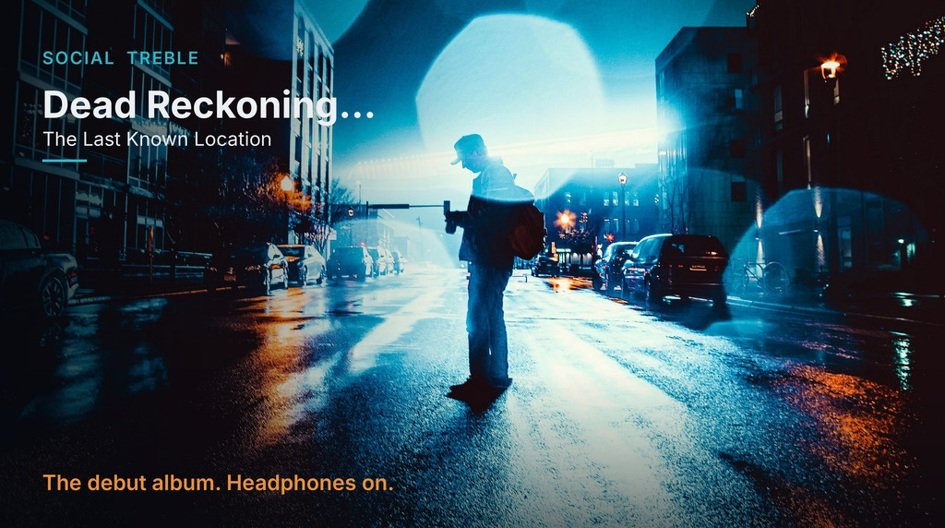
Dead Reckoning… The Last Known Location is a debut binaural audio album about a man the system knows completely and the 224 seconds he has to vanish.
At six o’clock in the morning a chrome drone hums beside a man’s right ear, so close and so exactly placed that you would swear it was hovering over your own shoulder. That is the trick of a binaural audio album, and it is the reason the one I am releasing today cannot be played through a speaker. The man is Token AS-1133. The story around him was inspired by a real one, and that is all I intend to say about where it came from.
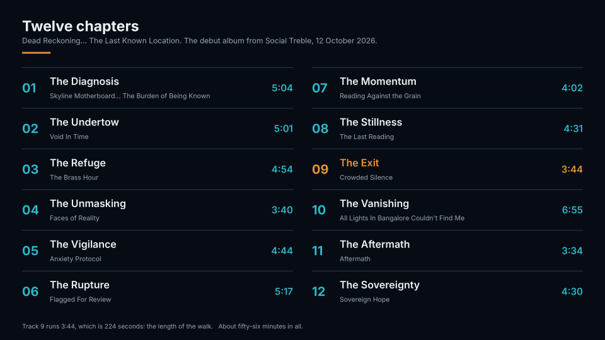
Dead Reckoning… The Last Known Location is the debut album from Social Treble, released on 12 October 2026. It holds twelve instrumental chapters, about fifty-six minutes in all, set in Bangalore in 2031, where a network called SOMA sells the attention of every citizen in real time. The Bandcamp page lists all twelve tracks and their lengths, and the film on YouTube speaks each chapter aloud before its music begins.
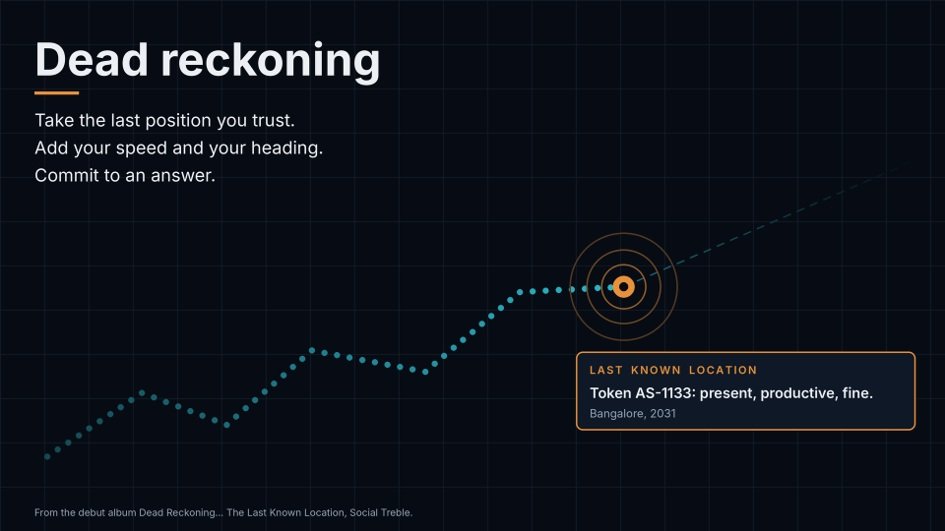
The title is a navigator’s term. Dead reckoning is how a ship found itself before satellites: take the last position you trust, add your speed and your heading, and commit to an answer. In this story the last known location is a line in a database, and the line says that Token AS-1133 is present, productive and fine.
A Number Where A Person Should Be
In Chapter 2, The Undertow, AS-1133 does exactly what the company portal advertises. He files a wellness flag. The system accepts it, stamps the time, hands him a twelve-digit tracking number (nobody can read twelve digits aloud without sounding like a hostage) and returns him to his task list. Nobody walks down the hall. His distress has been recorded, timestamped and stored, which turns out to be entirely different from being helped, and the second chapter of the film says so in nearly those words before the music starts.
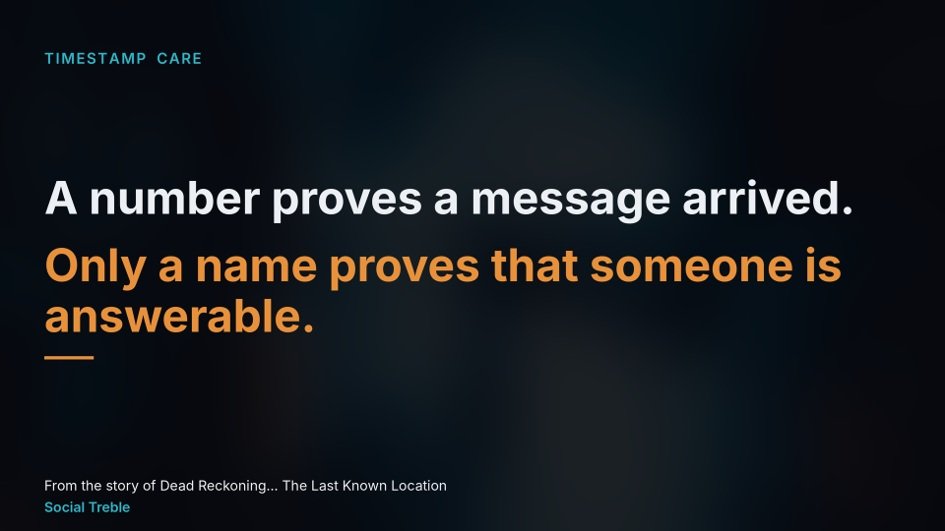
I have a name for that gap. Timestamp Care is the pattern in which a system logs and time-stamps a person’s distress, returns a reference number and sends no human to answer it. A number proves a message arrived. Only a name proves that someone is answerable.
What follows the number is quieter than the filing. AS-1133 learns to wear a calm face. An Affective Proxy is the practiced display of composure a worker maintains for colleagues and sensors while the real state underneath goes unreported. In Chapter 4, The Unmasking, he sees it on everyone around him, in the half-second pause between a joke and a laugh, and the discovery costs him more than the flag did, because it means no adult is waiting higher up.
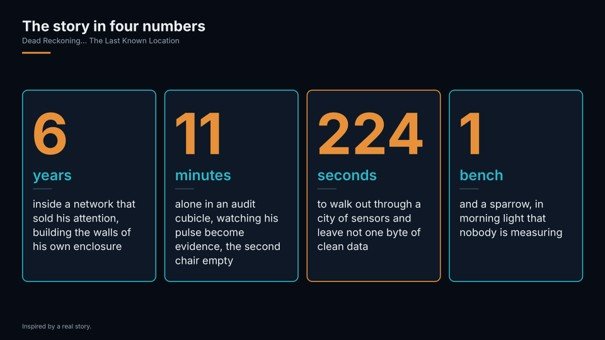
Then comes the cubicle. In Chapter 6, a flicker of distraction in a meeting is logged as concealment, and he stands for eleven minutes while a wall of screens replays six hours of his own face. His pulse rises, and the interface logs the rise as guilt. A second chair in the room stays empty. An empty chair is the loudest object in any office. I read the scene as Systemic Context Blindness with a floor plan, a system unable to judge a person inside the context that produced him, which is the same blindness the Srutio Social essay on Comfortably Numb defines in a very different song.
Two Hundred And Twenty-Four Seconds
The way out is a piece of paperwork. In Chapter 7, Reading Against the Grain, AS-1133 stops watching the dashboard and downloads the thousands of dry pages every employee thumbprints and never reads. He finds a clause that an early legal team wrote and the parsing software forgot: Voluntary Decommissioning. A token may leave the network without penalty if it stays unseen by the sensor mesh for 224 seconds, and the film’s seventh chapter states the clause plainly.
Most escapes in fiction are explosions, but the ones that work are dull, aren’t they? This one is clerical, patient and read four times before he believes it. The fear stays with him. For the first time in six years, it has a practical purpose.
Chapter 9, The Exit, lasts as long as the walk. The Bandcamp page lists the track at 3:44, which is 224 seconds, and the spoken chapter that introduces it in the film runs one minute and twenty-nine seconds. AS-1133 goes down the main commercial avenue of Bangalore, through the thickest sensor grid in the country, with one hand closed around an old brass tuning fork in his coat pocket. The scanners throw errors. The projected city peels away, and under it there is a small park, a weathered bench and a brown sparrow landing in light that nobody is measuring. (Why a sparrow and not a pigeon? A pigeon would have turned the ending into a joke.) He sits down on the bench.
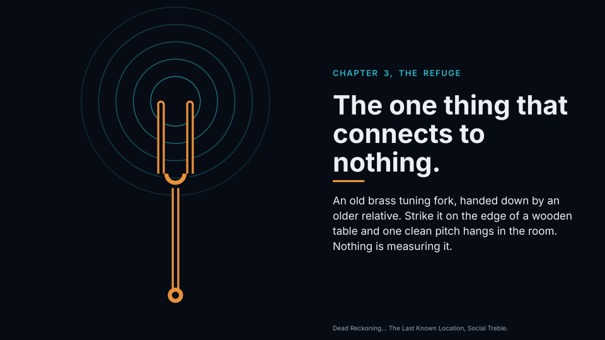
The fork is the detail I keep returning to. Chapter 3, The Brass Hour, introduces it as the one object in his life that connects to nothing, which in a city of sensors makes it the only honest thing he owns. Strike it on the edge of a wooden table and one pitch hangs in the room. No model is waiting to measure it. It is the opposite of a ticket number.
How To Put A City Around Someone’s Head
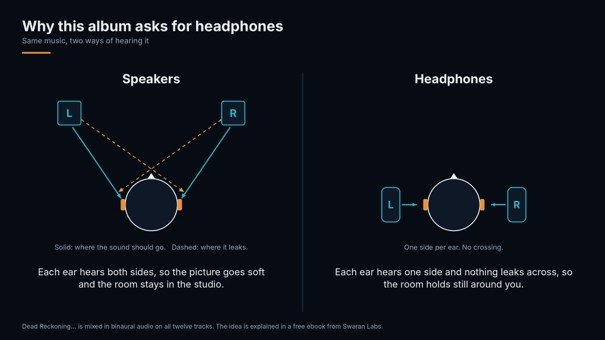
A binaural audio album gives each ear its own version of the music, so that your brain can do what it has always done in a dark room, which is work out where things are. Lord Rayleigh described the two cues in 1907, a difference in timing between the ears and a difference in loudness and tone, and Chapter 4 of my free ebook, How To Produce Binaural Audio Effectively, explains them step by step. Every instrument on this album was placed by hand at a fixed distance and angle from your head, the way you would arrange furniture in a dark room you plan to cross with your eyes closed. Nothing circles around you. The room holds still so that you can walk through it.
That is why speakers will not do. Through speakers each ear hears both channels, and the cues dissolve. Laptop speakers, a phone propped against a mug and the Bluetooth cylinder in the kitchen will each play the notes, politely, and none of them will play the place. The architecture stays home. This is not binaural beats either: nothing here claims to change your brainwaves, only to put the furniture in the right place. I could say more about the ears, and the ebook does, so I will leave the thought there. The book is free, asks for an email address, and is written for anyone who wants to build the same kind of picture.
If you want to understand how to effectively produce true binaural audio check out the free e-book on Swaran Labs, How To Produce Binaural Audio Effectively.
What Is Left When Nothing Is Measuring
Chapter 10, The Vanishing, is the one I wanted most. The network now lists AS-1133 as silenced, its clinical word for dead, and in the street his lungs draw deeper air than they have since he was twenty-two. He walks down the middle of the pavement, visible to any tea seller who cares to look and invisible to everything that governs the street. That is where the Analog Ghost is born.
The last two chapters are the ones I was afraid of. Chapter 11, Aftermath, is the dawn waking for an inspection that is no longer coming, and the agreeable face composed in the bathroom mirror for cameras that are not there. Leaving a system does not cure what the system did. Chapter 12, Sovereign Hope, is what the hands do next, in the late hours that used to belong to sprint deadlines, with the brass fork resting on the table beside the other tools. It is a warm piece, and I meant the warmth.
If any of this sounds like your week, you deserve a person and not a ticket number. Talk to someone you trust, and ask them for a name.
The album is on Bandcamp and, as a narrated film, on YouTube. Headphones on, volume low.
Bandcamp link: https://socialtreble.bandcamp.com/album/dead-reckoning-the-last-known-location-binaural-audio-48-khz-24-bit
YouTube link: https://youtu.be/FlMoKN1cky4
Check out what Social Treble is all about here: https://srutio.com/social-treble/