
Why Srutio Exists And Why Srutio Has Four Arms and One Standard
Four arms, one person, and a standard that has to survive its own evidence. The founding account of Srutio’s software, publication, music, and practice.
The occupation box usually leaves room for one answer. A person can spend years writing, building technical systems, and making music, then arrive at a form that would prefer two of those activities to disappear. Srutio grew out of work that kept refusing that tidiness. An explanation needed an engineer’s attention; a recording needed an editor’s judgment. Eventually, the connections needed a place to live where someone else could find them.
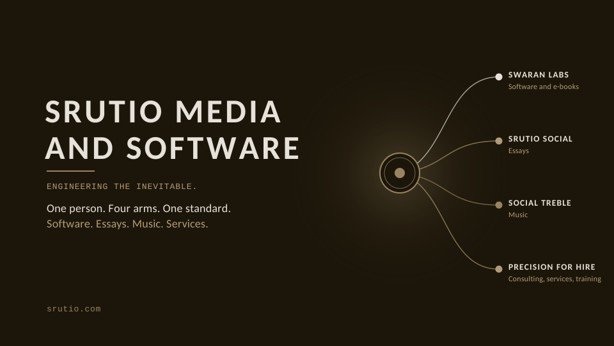
That place is Srutio Media And Software, an independent, India-based operation with four arms: Swaran Labs for software and technical learning material; Srutio Social for analysis and reviews; Social Treble for instrumental music; and Precision For Hire for consulting, services, and training. The public founding account identifies one person behind them, working as Eeshin and The Analog Ghost. Four doors give visitors a choice about where to begin. The shared standard concerns what happens after someone enters, when a piece of work starts occupying their time or asking for their trust.
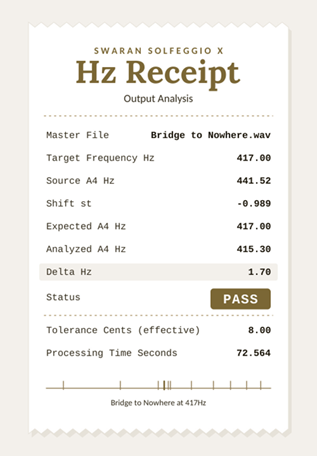
There is a small, awkward object in that account: a software receipt with 417.00 hertz requested and 415.30 reported. The numbers have been allowed to disagree on the company’s own website. A founding story generally prefers its evidence better dressed. Keep the receipt in view. Its unfinished-looking agreement will become useful after the four doors have been opened.
The Work Came Before the Arrangement
There is a familiar pressure to make a working life legible by removing the parts that trouble its label. Someone writes well, understands technical systems, and makes music; the label then asks which of those activities is the real one. The question can be useful when choosing a service provider. Applied to an entire person, it becomes a remarkably efficient way of discarding useful experience. You can feel the administrative tidiness of the answer before you discover what it has thrown away.
Srutio’s founding account describes journalism followed by years in enterprise technology architecture, alongside independent music work. It also describes roughly a decade of handling composition, recording, mixing, mastering, artwork, publicity, advertising, and distribution beside a full-time job. That history matters because the tasks repeatedly met inside actual deliveries. A release needed a coherent story as well as finished audio. A technical system needed an explanation another person could act on. The names of the departments changed; the consequences of a weak handoff remained familiar.
The current public chronology is more compact. Social Treble’s first release arrived in February 2026; Srutio Social’s essays began in July; the broader portfolio and practice launched in October, according to the dated Srutio founding line. Those dates describe the appearance of the current arms, rather than the beginning of every skill used to build them. An October website can contain a much older argument. In this case, the argument had already spent years being tested against finished work and the irritating little jobs that surround it.
A glamorous account of that history would linger over creative independence. The less glamorous detail is more useful: responsibility continued after the attractive part of the task was finished. A song still needed metadata and distribution. A diagram still needed requirements that matched it. The person doing the work, and yes, the unromantic spreadsheet deserves its moment here, had to carry the consequences across those boundaries. That continuity is part of the reason the eventual structure makes sense.
I built Srutio because the work had already started connecting these disciplines long before they shared a name. The founding account describes a decade of carrying a release from composition to distribution beside a full-time job. Learning another skill often meant getting the work the rest of the way to its listener. The eventual arrangement gives that habit four public entrances. Its usefulness belongs in the delivered work, where somebody other than its maker gets to decide whether the connection helped.
Four Doors Need a Reason to Share a Building
Consider the point where a piece of writing becomes a tool, or a tool becomes a creative decision. An audio problem can demand software. Explaining the software can demand editorial discipline. Hearing what the change does can demand musical judgment. Someone asking for help may need the combination rather than a separate invoice from each discipline. These are hypothetical routes through a real structure, and the distinction matters: a plausible connection is a reason to design an operation, not evidence that every connection has already produced a commercial result.
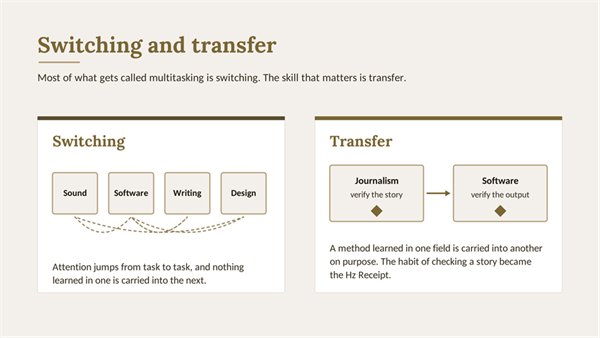
The Srutio practice page calls its cross-disciplinary method Relative Synthesis: applying a method from one discipline to another problem because its structure is relevant. The useful word is relative. A musical intuition needs a reason to enter an architecture discussion; a technical method needs a reason to enter an essay. Familiarity with both subjects is the beginning of that judgment. It cannot finish the argument by itself.
There is a danger in making every activity look related after the fact. Anyone can draw arrows between four boxes. The diagram becomes useful when a particular arrow explains a decision that would otherwise be worse, slower, or harder to examine. A software tool emerging from an actual audio problem supplies a stronger connection than a slogan about interdisciplinary thinking. Srutio’s Swaran Labs portfolio supplies that specific connection in its account of retuning and spatial-audio learning material.
Different doors also spare the visitor some unnecessary decoding. A reader looking for an album review should arrive at a publication. A customer looking for a Windows application should arrive at the tool and its requirements. A person seeking a scoped engagement should find a practice with a clear way to begin. Those are the separate routes the portfolio provides. Someone can enjoy a record without becoming interested in a consulting practice. That freedom is part of making the arrangement hospitable.
Future expansion could add another arm and reopen the discussion about the diagram. A diagram with one more box would certainly fit on the website. Then someone would arrive needing help with one particular thing, and the extra box would become the least interesting part of the conversation. The person would still need a result they could recognise. That is where this arrangement has to meet them.
Swaran Labs: A Tool Has to Survive Its Own Claim
Swaran Labs is Srutio’s software and learning arm. Its public portfolio says its first products concern sound while leaving the wider software remit open. That is a sensible distinction. A first application gives a company a place to demonstrate its method; it need not become a permanent border around everything the company can build. The present evidence concerns the products that exist, and their claims should remain specific to those products.
Swaran Solfeggio X is described as a Windows application for retuning an audio track’s reference pitch, measuring the resulting output, and checking it against the target. The product page calls the verification mechanism Śruti Lock. Reference pitch matters here: a piece of music contains many frequencies, so calling an entire recording a single frequency would muddle the very claim the tool is meant to clarify. A title containing a number creates an expectation. A measurement explains what was actually checked.
Return to the published receipt. It gives a target of 417.00 hertz, an output of 415.30 hertz, and a gap of 1.70 hertz; the Srutio portfolio describes an eight-cent tolerance. The displayed pass therefore belongs to a tolerance rule, rather than to exact equality. The receipt even records a processing time of 72.564 seconds, a precision of reporting that will contribute absolutely nothing to choosing dinner. Its useful contribution is that the result remains visible at the point where the marketing could have stopped talking.
The gap stays on paper. That makes the claim easier to examine, and it also limits the claim: this is a company-published example, rather than an independent certification of every possible input. A prospective user can inspect what is being reported and decide whether the tolerance suits the intended use. There is no need to attach a healing promise to a reference-pitch adjustment. Audio engineering claims can be useful at their actual size.
The learning material makes a related demand. How To Produce Binaural Audio Effectively is presented as a free, fourteen-chapter guide with linked documentation and a fifty-eight-instrument reference table. Its public description distinguishes spatial positioning for headphone listening from binaural beats. That distinction prevents two different subjects from borrowing each other’s reputation. The practical value lies in explaining a method clearly enough that the reader can compare its advice with the sources.
The most revealing detail appears in Srutio’s account of the reference table: an earlier draft filled cells with numbers that could not be justified, and the correction used none where no processing profile honestly fitted. I had made the table look more complete than its evidence allowed. The correction removed something a reader might otherwise have copied simply because it was there. A justified blank is useful. That deserves a closer look.
Srutio Social: Understanding Also Needs an Output
A publication produces a different kind of object. You cannot run an essay through a pitch meter and call the argument verified. You can inspect its sources, follow its reasoning, and notice where an interpretation is being offered as an interpretation. Srutio Social’s founding statement describes culture as a diagnostic instrument for professional and personal life. The ambition is to make a condition clearer through the close reading of something people already encounter.
The five sections have distinct jobs. Culture Audit uses cultural material to examine lived patterns; Business Audit examines commercial and institutional claims. Music Matters attends to records as records, while Gear Matters examines the tools used to make things. Transmissions carries the operation’s own statements. A founding article belongs in that last room because its subject is the arrangement speaking about itself.
The difference is visible in the archive. The Vienna essay connects a song with professional pressure, while the Kashmir essay examines exhaustion and the difficulty of stopping. Those are interpretive uses of cultural material. Their usefulness depends on the quality of the connection, with factual claims still requiring sources. A reader should be able to disagree with a reading without having to guess which parts were reported facts.
There is a small kindness in giving an experience language precise enough to discuss. Someone who cannot explain why a workplace feels wrong may gain a question to take back to it. That does not turn an essay into therapy or make the publication a clinical authority. It gives the reader an analytical object, something available for examination rather than a feeling that must remain privately embarrassing. The distinction keeps the ambition humane and proportionate.
An essay that leaves one useful distinction behind is more satisfying than a motivational speech with perfect lighting. Readers are free to prefer the speech. The Vienna essay puts that preference into practice by giving professional pressure a cultural point of reference that can be argued with. Someone can return to its reasoning after the first reading. The publication’s usefulness includes that second encounter, when an attractive sentence has to survive a less accommodating question.
Social Treble: A System Can Be Heard From Inside
Social Treble gives Srutio a musical form. Its first full album, Dead Reckoning… The Last Known Location (Binaural Audio), was released on 12 October 2026. Twelve instrumental chapters move through one fictional world in binaural audio intended for headphones. The four earlier singles now sit inside a complete sequence rather than standing as the whole available body of work. A genre label can point towards instrumental cyber-prog; the album has to justify the time it asks a listener to give it.
The record enters a near-future Bangalore where attention can be treated as property through a Persistent Cognitive Token. AS-1133, the Ghost variable, compliance drones, and Yield scores belong to that fiction. The album was inspired by a real story, but it is neither a memoir nor a literal description of present technology. Fiction can carry the pressure of a real condition without borrowing the identity of a real employer or person.
In the second chapter, a man files a wellness flag. The system stamps it, returns a twelve-digit number, and sends him back to work. The acknowledgement proves that the message arrived; it does not prove that a person answered. In The Last Reading, the eighth chapter, departure becomes an old canvas jacket, an open door, and a morning inspection that detects nothing unusual. The story does not defeat its system with a speech. It finds the quiet point at which a decision has already moved beyond the system’s measurement.
Instrumental music makes that arrangement possible. The full narration is available for listeners who want the authored sequence, while the record itself can be heard without first accepting a single reading of it. A listener may hear surveillance, exhaustion, relief, or simply twelve pieces with space moving around the head. Nobody has to pass an interpretation test before returning to a track.
The relationship with Swaran Labs is practical. The free binaural guide explains production methods; the album demonstrates one finished artistic use. One should not serve as proof of the other. Outside reviews remain evidence that other people encountered the work, not proof that every technical or artistic claim is settled. The strongest connection is modest: a method explained in one arm becomes an experience another arm lets the listener judge.

Precision For Hire: The Standard Enters Someone Else’s Deadline
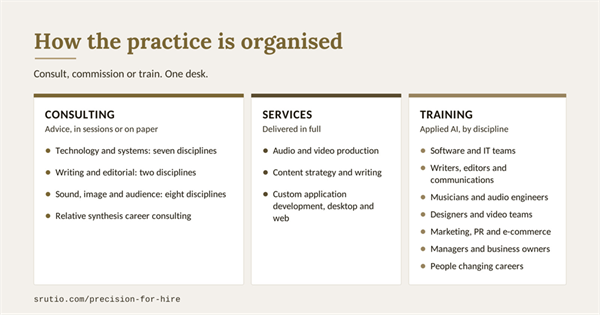
A personal project allows its maker to choose what matters next. A client engagement introduces someone else’s objective, budget, and deadline. Precision For Hire is Srutio’s arm designed for that encounter. The public page separates consulting across seventeen disciplines from direct services and applied AI training. The distinction helps a prospective client tell advice from execution and either of those from learning to perform a task independently.
The disciplines span technical architecture, automation, writing, music, audio, visual direction, video, growth work, and commerce. Their breadth can be useful when a problem crosses boundaries, but breadth increases the duty to state a particular engagement’s limits. A list of seventeen disciplines does not establish equal depth in every possible subfield. The practice’s relevance has to be decided against the actual problem. A clear refusal can save more work than an enthusiastic proposal.
The Srutio engagement sequence begins with the work, the deadline, and the description of a good result. It proceeds through a fit discussion to written scope, deliverables, timeline, and fee agreed before work begins. Those details are the practical meaning of a professional standard. They give both sides something more durable than a promising conversation. You should be able to recognise the result you agreed to receive, shouldn’t you?
Relative Synthesis becomes useful here when a transferred method has a defensible role. Editorial judgment can improve a technical document because an explanation must survive a reader’s uncertainty. Systems thinking can improve a content operation because repeated decisions need reliable inputs and ownership. These are examples of how a method could transfer, rather than promises of a universal cure. The proposal still has to explain why the particular transfer belongs in the particular job.
The practice page’s account of applied AI training is similarly task-based: use the participant’s real work, inspect an output, compare it with evidence, and decide what to accept or correct. The educational object is judgment in a concrete task. Neither a tool demonstration nor a certificate, by itself, establishes that judgment. The value would appear in what the participant can subsequently evaluate. A practice earns trust at the point where a client can work without its vocabulary.
One Standard Makes the Founder Easier to Question
There is a temptation to treat Srutio’s four-arm arrangement as a declaration of range. That reading leaves its most demanding feature untouched. Shared ownership removes the comfortable excuse that a different department made the claim. The founding page names honesty, integrity, accuracy, efficiency, and value as its standards and places examples beside them. The purpose of naming those standards is to make future work easier to question against them.
Honesty includes the visible gap in the published retuning receipt. Accuracy includes a source that supports the sentence actually written. Integrity includes keeping formal status clear: the IP India eRegister records Class 9 trademark application 7587797 for Srutio’s name, tagline, and device, filed on 11 March 2026 and marked Ready for Examination as of 7 October 2026. That is a filed application awaiting examination, not a granted registration. The distinction is small enough to fit in a sentence and important enough to keep there.
Efficiency asks whether effort improves the result or merely makes its maker look occupied. Value asks what another person receives for the money or attention given. The Srutio portfolio points to software sold through a single payment, a free first learning title, and work agreed through written scope as examples of its intended approach. Those are inspectable arrangements. They do not, on their own, prove that every buyer will find equal value. The customer’s task remains the scale at which usefulness is decided.
Claim Rent is the continuing work required to keep a published claim deserved, including accessible evidence, corrections, and limits after the first announcement. The reference-table correction supplies a small example of that work. A claim has already occupied someone’s attention when its maker discovers the information was too confident. Correcting it costs another pass through the material, and the reader deserves that pass. The phrase names an obligation that continues after the attractive work of announcing something is over.
The cost becomes real when the standard makes a release less flattering. An empty reference-table cell is an example. A tolerance statement that leaves the numerical gap visible is another. The useful question is what happens when the evidence spoils the attractive version. A founding story that cannot survive that moment is only a preferred description of its author. An operation needs a correction path as much as it needs a public name.
None of this grants automatic trust. A solo publisher can misread a source. A tool can fail on an unfamiliar input. A scoped engagement can need a correction. Concentrating responsibility in one person makes those risks easier to locate while also making capacity and continuity important. Srutio deserves examination precisely because its claim is ambitious. It should make that examination cheaper for the person doing it.
Independence Has to Leave Room for Other People
The public identity is deliberately bounded. Eeshin is the publication and practice name; The Analog Ghost is the musical identity; both refer to the same person. The operation is built in India, while the work is intended to be usable wherever its subject is relevant. A reader can inspect an argument without a private employer history or an inbox full of somebody else’s messages. The public record should carry the claims being made publicly; it need not turn every person encountered along the way into supporting material.
The musical reference behind the name Srutio comes from shruti, associated with fine pitch distinctions in Indian classical music. It offers an apt starting point for an operation interested in differences that a convenient label can conceal. A schematic of traditional intervals should not be mistaken for a claim that those intervals are equally spaced. The useful implication is smaller and more practical: a distinction deserves attention when overlooking it changes what someone understands or receives.
That boundary also protects people who never agreed to become material for a founding story. Professional experience can inform judgment without turning a former workplace into a named anecdote. An independent business can explain its method without publishing a client’s confidential task. Privacy and accountability can coexist when the evidence offered matches the claim being asked of the audience. A private biography is a poor substitute for a public correction.
The same restraint applies to scale. Srutio’s four arms can describe four kinds of work without implying four staffed companies. A software arm can have a wider remit without announcing products that do not exist. A practice can discuss its available disciplines without promising unlimited capacity. Clear boundaries give visitors a fair chance to decide whether this operation fits their need. They also leave the maker room to say that a task requires someone else.
What would make the arrangement worth keeping together? A reader finding language that clarifies a difficult pattern is one answer. A user finding a tool whose result can be checked is another. A listener finding a work worth returning to, or a client receiving the result described in the scope, supplies a different answer again. These outcomes need their own evidence. The connection between them becomes useful when the care learned in one makes the next more trustworthy.
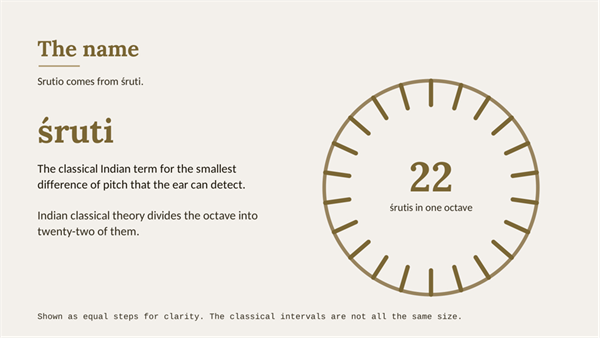
The name refers to musical distinctions. Diagram spacing is illustrative, not a claim of equally spaced intervals.
The Receipt Is the Founding Statement
The occupation box at the beginning can keep its single answer. The Srutio receipt has room for two: what was requested and what was reported. Its gap remains visible, with the tolerance that explains the pass. That small record gives the four-arm arrangement somewhere to answer to, beyond the satisfaction of making the diagram fit.
I wanted the different parts of this working life to have somewhere useful to meet. Four doors let another person enter through the work that matters to them. The receipt keeps its two unequal numbers. A receipt can disappoint you. That is part of its value.
The standard belongs in the gap.
Find out what “Dead Reckoning… The Last Known Location” – A Binaural Audio Album by Social Treble actually is.