
Why WA Production’s DeNoizzer Is the Scalpel Your Noisy Recordings Have Been Begging For
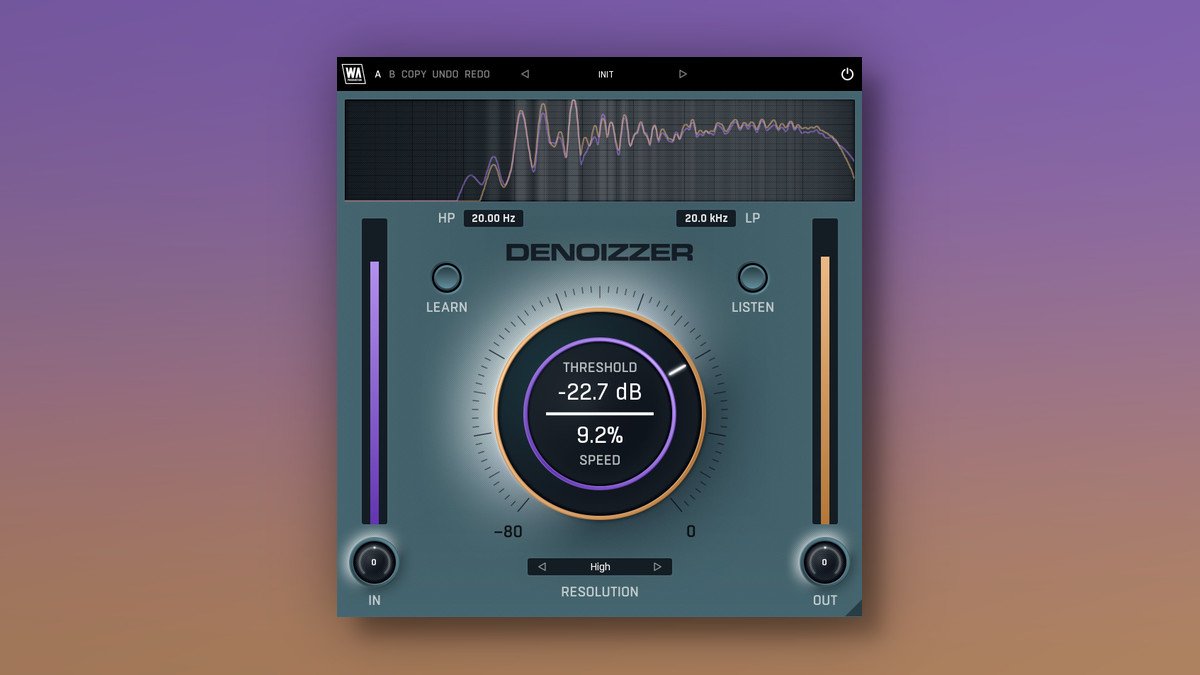
WA Production DeNoizzer. Under $10 on sale. Learns the noise fingerprint and removes it clean. The scalpel your recordings needed.
A traditional noise gate is a sledgehammer. It opens when the signal is loud enough and closes when it is not, and everything in between, the room tone, the breath, the tail of the reverb, gets chopped off at the knees. Gating a vocal in an untreated room does not remove the noise. It removes the noise only during the silences, which means the hiss appears and disappears in time with the words, and the human ear finds that considerably more distracting than constant hiss.
DeNoizzer works differently. It learns the specific spectral fingerprint of the noise and subtracts that profile from the entire signal, which is closer to a scalpel than a sledgehammer, and at under ten dollars on sale it is basically the cheapest scalpel in the building. The technique is spectral subtraction, and it has existed in expensive restoration suites for decades. What is new is the price.
The workflow is straightforward. Select a section of audio that contains only the unwanted noise, let the plugin learn its spectral profile, and then apply the reduction across the whole recording. It is not magic, but it is honestly close enough for most sources. The critical requirement is that you have a clean noise-only section to sample from, which means leaving a few seconds of room tone at the top of every take. Engineers have been recommending that for fifty years and most people still do not do it.
Advantages
The price-to-performance ratio is the primary selling point. At under $10 on sale, DeNoizzer competes with tools that cost ten times as much for the common tasks. It will not replace iZotope RX for forensic restoration work, but for the eighty percent of noise problems a home studio actually encounters, the gap is smaller than the price difference suggests.
The learn-and-remove workflow is intuitive enough that a first-time user can get a usable result in about two minutes. The CPU load is light, which matters when you are running it across a dozen dialogue tracks. For steady-state noise, hum, hiss, air conditioning drone, the results are clean and usable with minimal artefacts.
Disadvantages
DeNoizzer struggles with intermittent or variable noise sources. If the noise changes character over the recording, the single learned profile cannot keep up, and you get either under-reduction or the classic underwater artefacts that make processed audio sound like it was recorded in a swimming pool.
It is a specialist for steady noise, not a general restoration suite. Clicks, pops, crackle, and broadband transient noise are outside its remit entirely. Push the reduction too far on any source and the artefacts arrive quickly, so the useful range of the main control is narrower than the range it offers. For complex broadband problems, you still want the expensive tools.
Use Cases
Podcast and voiceover cleanup: learn the room noise during a silence gap, apply the profile, and lift the hiss out of an untreated room. This is the single most common use and the one it handles best.
Home recording rescue: the fan, the fridge, the streetside window, all the steady intrusions a bedroom studio cannot avoid.
Location dialogue: steady ambient beds under recorded speech come out cleanly when the noise floor holds constant, which on a controlled interior shoot it usually does.
Why WA Production’s DeNoizzer Fails on Variable Noise
The limitation is structural rather than a shortcoming in the implementation, and understanding it tells you exactly when to reach for something else. Spectral subtraction builds a frequency-domain profile of the noise, then subtracts that profile’s magnitude from every subsequent frame of audio. The method assumes the noise is stationary, meaning its spectral shape stays constant across the recording. Hum, hiss, and air conditioning drone satisfy that assumption almost perfectly. Traffic, wind, and a fridge compressor cycling on and off do not. When the actual noise diverges from the learned profile, the subtraction removes the wrong frequencies and leaves behind isolated spectral peaks that the ear reads as the underwater artefact. That is not a bug. It is the price of the technique, and it is why the expensive restoration suites exist.
Check out the plugin from WA Production’s official website
Do you use Native Instrument’s Kontakt in your production workflow? Then you might want to see Why Shreddage 3 Electro Sitar Is the Psychedelic Era in a Kontakt Patch


One Comment
Comments are closed.