What Two Students From Indian Villages Actually Found in a Gap Nobody Else Wanted
Two BITS Pilani students built India’s most-funded hyperspectral satellite company by testing a gap every major satellite firm had already walked away from. Full audit.
In 2018, Ahmed and his BITS Pilani classmate Kshitij Khandelwal were competing in the IBM Watson AI Challenge, trying to build a model that could analyze crop health from satellite imagery. The idea itself was not original. What happened next was. They went looking for satellite data detailed enough to catch early crop disease, and found that no such data existed anywhere in the market, not from any major satellite company they contacted. Conventional Earth observation satellites captured the planet in three or four spectral bands, roughly what the human eye sees. Nothing available could see enough of the spectrum to catch a problem before it became visible to a farmer standing in the field.
This is the part of the story that gets compressed into a single inspirational line and deserves more scrutiny than that. Ahmed and Khandelwal did not have a business plan. They had a specific, narrow technical failure, a competition entry that could not be finished because a category of data simply did not exist, and they treated that failure as information rather than a dead end. Awais Ahmed had already spent his BITS Pilani years with Team Anant, the institute’s satellite project run alongside ISRO, and as engineering lead for Hyperloop India, the only Indian team to reach the finals of SpaceX’s Hyperloop Pod Competition. Khandelwal came through the same campus with a background in electrical and electronics engineering and prior experience at DRDO, India’s defence research agency. Neither of them had run a company before. Both of them had already spent years getting close enough to real aerospace engineering to recognize a genuine gap when they hit one, which is a different and rarer thing than simply noticing that a market is uncrowded.
The instinct to check whether the gap was real rather than assume it, which is the same discipline this essay is trying to apply to their own story, is what separated this from a college project that stayed a college project. Ahmed has described reaching out to major satellite imaging companies directly to ask why the data he needed did not exist, rather than assuming a shortcut existed that he simply hadn’t found. The answer he got back, consistently, was that the resolution he wanted was not commercially viable to build. That answer became the founding thesis, not a footnote to it.
Why Investors Called This Implausible
Pixxel was founded in February 2019, while both were still undergraduates, funded initially with money borrowed from Ahmed’s father. For a stretch afterward, the two lived on roughly ten thousand rupees a month between them, working wherever they could find space to work. When they approached investors, the response was consistent and, on paper, reasonable: two college students with no aerospace industry experience building satellites was not a credible pitch. It is worth sitting with why that skepticism was rational rather than dismissing it as investors simply failing to see the future. Building and launching a working satellite is genuinely hard, capital-intensive, and unforgiving of amateur mistakes. The skepticism was not wrong about the difficulty. It was wrong about who gets to solve a hard problem.
That distinction is the actual mechanism worth naming, and it explains far more about what happened next than ambition or grit alone. Call it the Abandoned Market Thesis: a market becomes available to new entrants without deep institutional access not when it is easy, but specifically when the organizations with the most resources have already concluded it is not worth their attention. Every major satellite company Ahmed and Khandelwal contacted in 2018 had, functionally, made that judgment already. High-spectral-resolution Earth imaging was a real, definable capability gap, and the companies best positioned to close it had decided the market for it was too narrow to justify the engineering cost. That decision, made by people with every institutional advantage Ahmed and Khandelwal lacked, is what left the door open.
It is worth being precise about what this thesis does and does not claim, since a story this inspirational is exactly the kind that tempts a lazier version of itself into the room. It does not claim that being an outsider is an advantage in general, or that inexperience is somehow a hidden asset. Most gaps that well-resourced incumbents walk away from are correctly abandoned, unprofitable for good reason, technically unsolvable at reasonable cost, or simply not worth anyone’s time regardless of who attempts them. The thesis only holds in the narrower case where the incumbent’s decision was an economic judgment rather than a technical impossibility, and where an outsider with genuinely adequate technical grounding, not zero grounding, chooses to test that judgment directly instead of accepting it secondhand. Ahmed and Khandelwal had exactly that grounding, from Team Anant, from Hyperloop India, from DRDO. What they lacked was capital and a track record, not competence.
What Actually Got Built
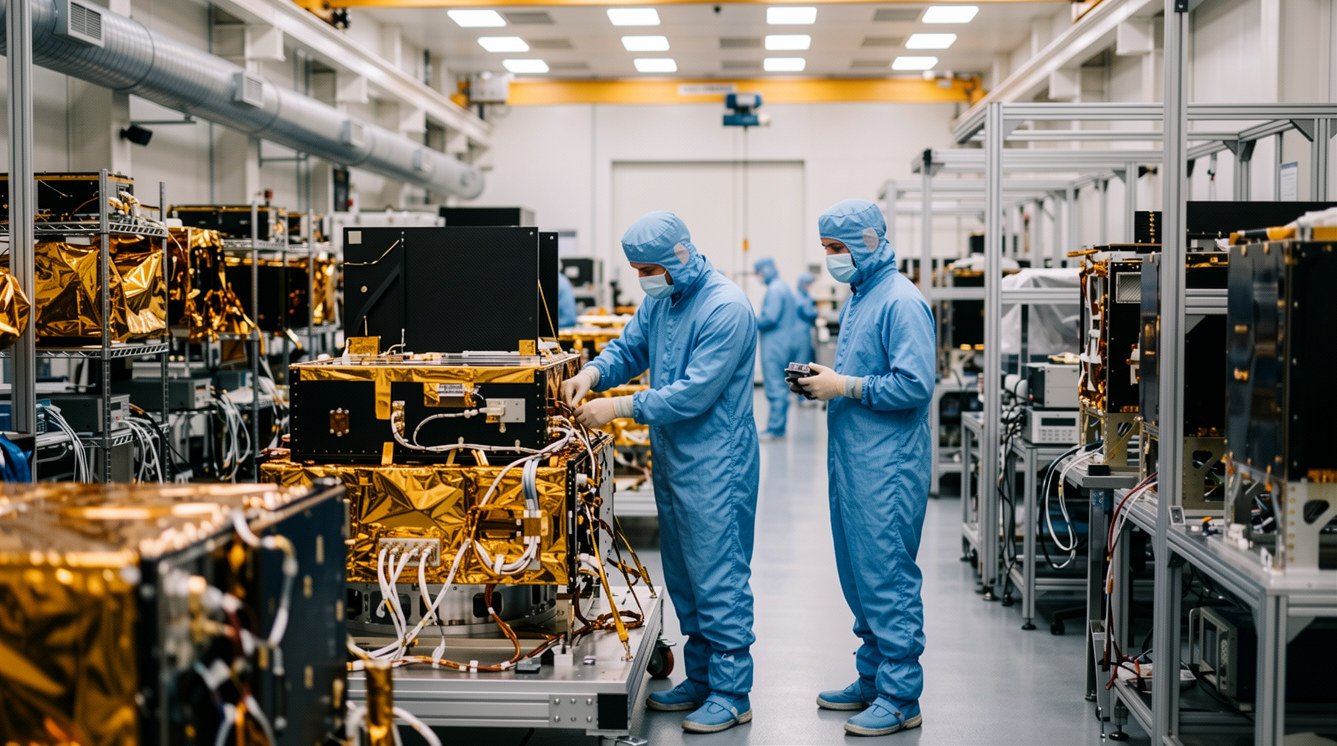
The claim only matters if the results are real, so the results need to be stated precisely rather than rounded up for effect. Pixxel launched its first satellite, Shakuntala, alongside a companion technology demonstrator called Anand, on a SpaceX Falcon 9 rideshare mission on April 1, 2022, becoming India’s first private hyperspectral satellite in orbit. Both were compact, sub-15-kilogram CubeSats built to prove the underlying technology worked at all, not to operate commercially. The commercial constellation, named Firefly, followed in 2025: three satellites launched in January aboard a SpaceX Transporter mission, and three more in August, bringing six operational Firefly satellites into orbit by the end of that year, each capturing more than 150 spectral bands across a 40-kilometer swath at 5-meter resolution. Pixxel’s own stated target for the full constellation is 18 satellites, with a further constellation named Honeybee planned for 2026 to extend coverage into short-wave infrared, expanding spectral coverage well beyond what Firefly alone can see.
The institutional recognition tracks the technical progress closely enough to be checked rather than taken on faith. In September 2024, Pixxel became the first Indian private space-tech company selected for a NASA contract, part of the agency’s $476 million Commercial SmallSat Data Acquisition Program running through November 2028. It separately signed a five-year data agreement with the US National Reconnaissance Office, the agency that operates America’s spy satellites. TIME named the company to its 100 Best Inventions list in 2023. On funding, the precise number depends on exactly when it is measured, and that precision matters more than a single impressive figure would: Pixxel’s own announcements confirm $95 million raised across disclosed seed, Series A, and Series B rounds, with backers including Google, Lightspeed Venture Partners, and Radical Ventures. Separate reporting from May 2026 describes a further round in progress, targeting $80 to 100 million in new capital at a valuation near $400 million, which would take the real total substantially higher once it closes. Both figures are stated here because both are real, and neither should be quietly collapsed into the other to make the headline number look cleaner than the evidence actually supports.
What the Gap Actually Rewarded
None of this required Ahmed and Khandelwal to be better engineers than the people at the companies that had already looked at this exact problem and walked away from it. It required them to still be looking at a market that everyone with more resources had already decided was not worth the trouble, at the exact moment demand for that capability was about to become undeniable. NASA’s own $476 million program is the clearest evidence available that the demand was real and large, not a niche curiosity two students happened to stumble into. The company now building a satellite named Pathfinder with AI startup Sarvam AI, designed to run data-center-grade AI compute in orbit and process hyperspectral imagery without waiting for a downlink, suggests the same underlying instinct, going toward the gap nobody else is contesting yet, rather than the crowded one, has not gone away now that the company can afford a very different kind of risk.
The most useful lesson here is not “two determined people can do anything,” which is true of almost nothing in aerospace and true of very little anywhere else either. It is narrower and more checkable: the most defensible markets are not always the ones with the biggest visible demand. Sometimes they are the ones every well-resourced organization has already inspected closely enough to correctly judge as difficult, and then incorrectly judged as not worth being difficult for. Aldur village had no internet. The gap Ahmed and Khandelwal found was sitting in plain sight the entire time, priced out of reach by exactly the kind of institutional caution that usually protects a market rather than exposing it.
Sources For Further Reading
- Pixxel official announcement, Series B extension funding, confirming the $95 million total, https://www.pixxel.space/news/pixxel-raises-24m-in-additional-funding-taking-its-total-series-b-raise-to-60m
- Wikipedia, “Pixxel,” confirming founding date, founders, and the April 1, 2022 Shakuntala launch. https://en.wikipedia.org/wiki/Pixxel
- The Better India, on Awais Ahmed’s background, the 2018 IBM Watson AI Challenge origin, and the founding circumstances. https://thebetterindia.com/324699/awais-ahmed-founded-space-startup-pixxel-hyperspectral-satellite-launch-hyperloop-india/
- YourStory, confirming Kshitij Khandelwal’s prior work at DRDO and Hyperloop India. https://yourstory.com/people/kshitij-khandelwal
- Pixxel official news release, confirming the Firefly launches, Kshitij Khandelwal’s statements, and the six-satellite operational count as of August 2025. https://www.pixxel.space/news/pixxel-launches-three-more-fireflies-with-spacex-paving-the-way-for-planetary-scale-hyperspectral-imaging
- Space-Startups.org, “Top Space Startups in India 2026,” current listing confirming all six Firefly satellites launched in 2025 and the $95 million funding figure. https://www.space-startups.org/country/India/
- StartupIndiaX, confirming the NASA Commercial SmallSat Data Acquisition Program selection, the NRO agreement, and TIME’s 100 Best Inventions recognition. https://startupindiax.com/awais-ahmed-pixxel-founder-story/
- Pixxel official news release, confirming the $95 million total across the Series B extension. https://www.pixxel.space/news/pixxel-raises-24m-in-additional-funding-taking-its-total-series-b-raise-to-60m
- Outlook Business, reporting a further $80 to 100 million funding round in progress as of May 2026 at a near-$400 million valuation. https://www.outlookbusiness.com/start-up/pixxel-expands-funding-round-to-100-mn-after-deepinder-goyal-steps-back
- Awais Ahmed, official LinkedIn post, confirming his meeting with Prime Minister Narendra Modi and the presentation of Pixxel satellite imagery. https://www.linkedin.com/in/awaisahmedna/
- eoPortal, technical mission documentation confirming spectral band counts and satellite specifications across Pixxel’s Shakuntala, Anand, and Firefly platforms. https://www.eoportal.org/satellite-missions/pixxel
Learn What India’s Production Linked Incentive Is And How It Matters For Doing Business In India Now