Welcome to Srutio Social: What This Publication Is Actually For
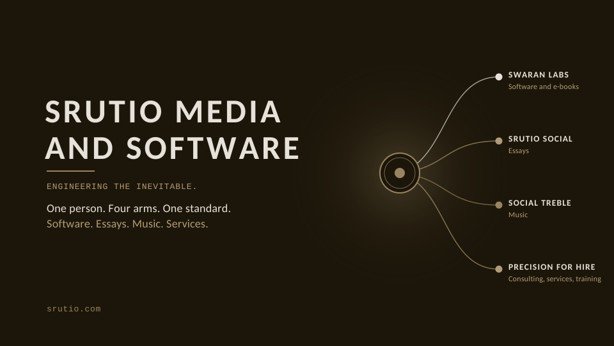
Srutio Social is a new editorial publication using music, film, and art as diagnostic instruments. Founding note by Eeshin
There are already too many publications on the internet. That is not a controversial statement. It is the starting condition. And yet here is another one. This is a founding note explaining why.
What Srutio Social Is Not
Srutio Social is not a music blog. It is not a culture site. It is not a productivity newsletter or a mental health publication or a career advice column, though it will occasionally look like all of those depending on which article you land on. Reducing it to any of those categories misses what it actually does. And the thing it does is quite specific.
Srutio Social uses music, film, and art as diagnostic instruments. That is the entire editorial premise. A song from 1977 becomes the sharpest available lens for understanding what is broken in a 2026 corporate office. A metal album from 2001 becomes the clinical diagnosis of the LinkedIn feed you scrolled through this morning. A Hindi film from 2015 becomes the exact explanation of the 3% raise that arrived last week. The art is not the subject. The art is the tool.
Why This Approach Exists
There is a particular kind of writing missing from the internet. Cultural criticism knows how to describe music. Business journalism knows how to describe corporate dysfunction. Nobody is systematically using one to diagnose the other. That gap is where Srutio Social lives. Every Culture Audit article takes a specific cultural artifact, verifies its factual context, and uses it to name something in the reader’s actual life that had no name before. The naming is the point. Once a condition has a name, you can see it. Once you can see it, you can decide what to do about it.
The publication runs three categories. Culture Audit contains the analytical essays that treat music and film as diagnostic tools. Music Matters covers album reviews and music features. Gear Matters reviews the hardware and software musicians actually use. There is a fourth category called Transmissions, which is where this note lives, for the occasional operational or editorial dispatch that does not fit anywhere else.
The Vocabulary
Every Culture Audit article introduces one or two proprietary concepts. Productivity Dysphoria, the specific unease of being extremely busy while producing nothing that bears your own fingerprint. The Aesthetic of Empathy, the compulsive conversion of private emotion into public content for algorithmic approval. Empathy Atrophy, the systematic degradation of compassion produced by algorithmic curation. There are seventeen of these concepts currently in circulation, and the target is twenty-five to thirty by end of year one. Each concept is defined in a single extractable sentence, on purpose, so it can be quoted, searched, and used.
The vocabulary is not academic. That is worth stating clearly. These concepts are named for immediate practical use, not for citation in a peer-reviewed journal. A professional who reads about the Subsidised Audit and recognises it in her own appraisal cycle has been given something specific. Not comfort. Not therapy. Just language sharp enough to make the pattern visible.
About the Byline
All articles are published under a single byline: Eeshin. The reasons for this are covered in a separate Transmissions piece. The short version is that anonymous editorial identity is unusual enough to explain, common enough to have precedent, and appropriate for a publication whose value comes from what the writing says rather than who is saying it. The name Eeshin is a Bengali derivative of a word meaning the observer.
There is an email list, if you want new pieces delivered directly. There is an RSS feed for the same purpose. There are no push notifications because push notifications are one of the specific dysfunctions this publication exists to diagnose, and it would be strange to deploy them.
Welcome. The archive is at your left. Start wherever the title pulls you in. Every article stands on its own, so there is no correct reading order. The concepts cross-reference each other where relevant, but nothing requires prerequisite reading.
The publication is called Srutio Social. The tagline is Where Art Dissects Reality. That is what it does. Now you know.
Sources and Further Reading
- Srutio Social Homepage: https://srutiosocial.com/
- Srutio Media And Software Overview: https://srutiosocial.com/about
- Editorial Contact: https://srutiosocial.com/contact
Read the article that started it all: Why Billy Joel’s “Vienna” Is the Corporate Survival Guide Nobody in 2026 Is Talking About