Why Noisemakers Binauralizer Studio 2 Is the Bridge Between Immersive Studios and Headphone Listeners
Noisemakers Binauralizer Studio 2 folds up to 22.2 immersive audio into convincing headphone binaural. The last-mile fix.
The problem with immersive audio in 2026 is the last mile. A mixing engineer can spend weeks crafting a perfect Dolby Atmos mix in a room with a dozen speakers, and then the listener plays it back on a pair of earbuds, and everything the engineer built collapses into a stereo smear. Apple Music, Amazon Music, and Tidal all deliver spatial audio to hundreds of millions of headphone users, which means the headphone render is not a fallback format. For most listeners it is the only format they will ever hear.
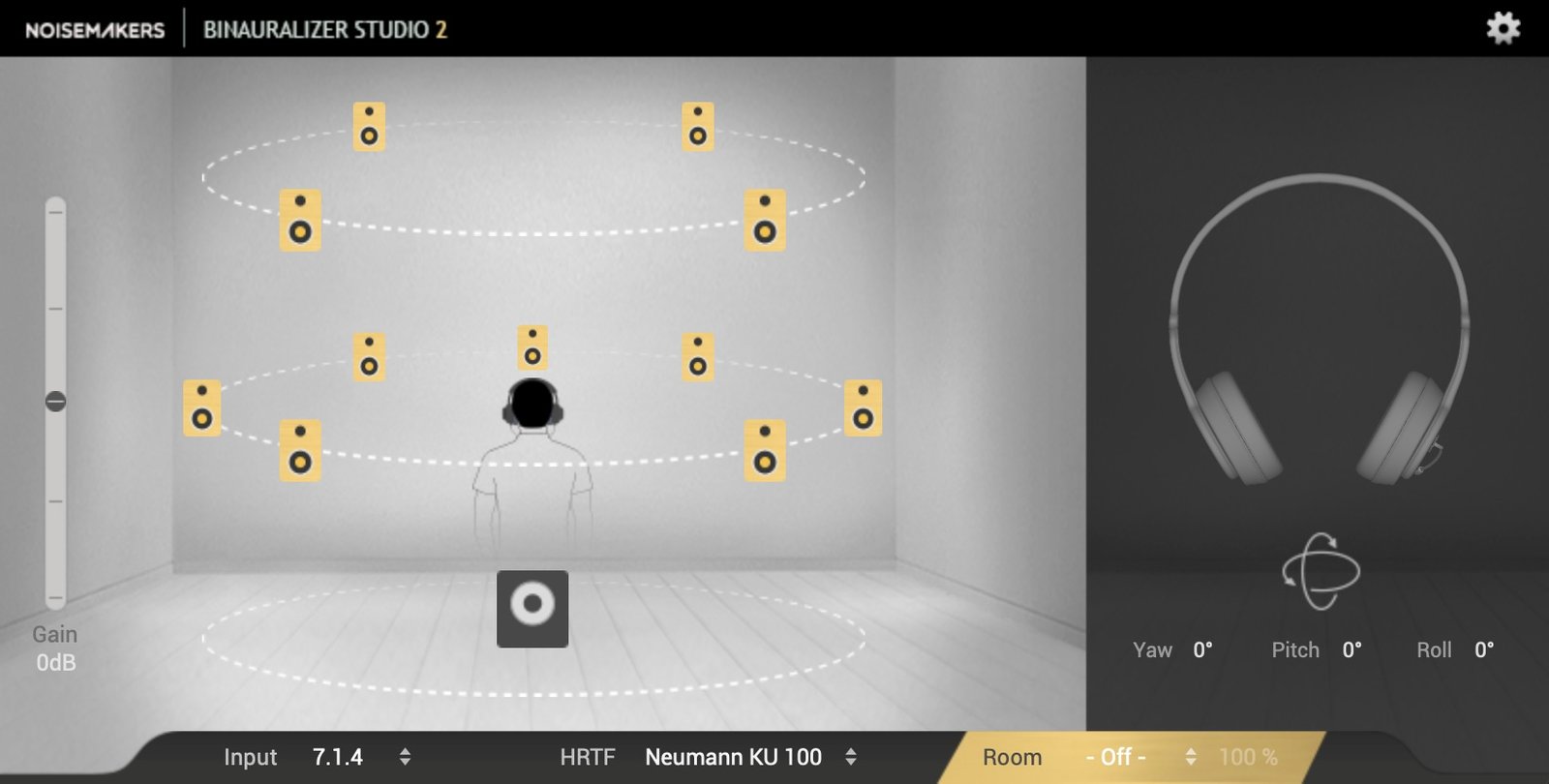
Binauralizer Studio 2 is basically the bridge across that last mile, converting immersive formats into a convincing binaural render for headphones. It handles surround and immersive formats up to 22.2 channels and folds them into two-channel binaural audio designed to preserve the spatial image.
The underlying technology is head-related transfer function processing, which models how the shape of a human head, torso, and outer ear colours sound arriving from different directions. The brain uses those colourations to locate sources. Reproduce them accurately over headphones and the brain places the sound outside the head rather than between the ears. Version 2 adds four significant features, and the room effect is the one that changes things.
Advantages
The BRIR room effect is transformative. Binaural room impulse response rendering adds early reflections and a modelled acoustic space to the HRTF processing, and switching from a dry anechoic rendering to a modelled room makes the binaural image feel natural rather than clinical. Pure HRTF rendering has always suffered from a slight in-the-head quality that no amount of positional accuracy fixes. Reflections fix it, because a real room has reflections and the brain expects them.
The support for formats up to 22.2 is comprehensive, covering everything from basic 5.1 through to full NHK-standard immersive layouts. For validating an immersive mix on headphones, or delivering a binaural version to headphone listeners, it does the job cleanly and honestly. At €89 it also sits well below the price of comparable tools from the larger immersive-audio vendors.
Disadvantages
Binauralizer Studio 2 is a specialist tool. It does one thing, and it does it well, but producers not working in surround or immersive formats have basically no use for it at all.
The HRTF-based rendering is also, by nature, a generalised model of human hearing. Everyone’s ears are shaped differently, and a generic HRTF is an average that fits nobody precisely. Some listeners get a startlingly convincing external image. Others get something that sounds slightly wrong in a way they cannot articulate. That variance is inherent to the technology rather than a fault in the implementation, but it means you cannot assume your reference experience matches your audience’s. It is not a universal fix.
Use Cases
Atmos mix validation on headphones: insert it on the master bus of an Atmos session to hear how the mix translates to earbuds before it ships.
Binaural content delivery: produce a dedicated headphone version of an immersive mix for platforms or clients that want a stereo deliverable with spatial character intact.
VR and game audio: preview spatial audio designed for headset playback without leaving the DAW, which saves an engine round-trip on every iteration.
Why Noisemakers’ Binauralizer Studio 2 Cannot Sound the Same to Everyone
The variance is inherent to the technique and worth understanding before you trust the result. A head-related transfer function is a measurement of how one specific head, torso, and outer ear colour sound arriving from each direction. The pinna folds are the critical structure, because their millimetre-scale geometry produces the spectral notches the brain uses to resolve elevation and to distinguish front from back. Those folds are as individual as fingerprints. A generic HRTF is an average that matches nobody exactly, which is why some listeners get a startlingly external image and others experience front-back confusion or an elevated source that should be level. The BRIR room effect mitigates this by giving the brain early reflections to work with alongside the HRTF cues, which is precisely why version 2 feels natural where version 1 felt clinical.
See the plugin in action yourself at NoiseMaker’s Official Website
While you are at it, why don’t you check out How the Nektar Impact LX mk3 Became the MIDI Keyboard That Stopped You Reaching for the Mouse