
How Holy Wave Crossed a Border to Find the Album They Could Not Make at Home
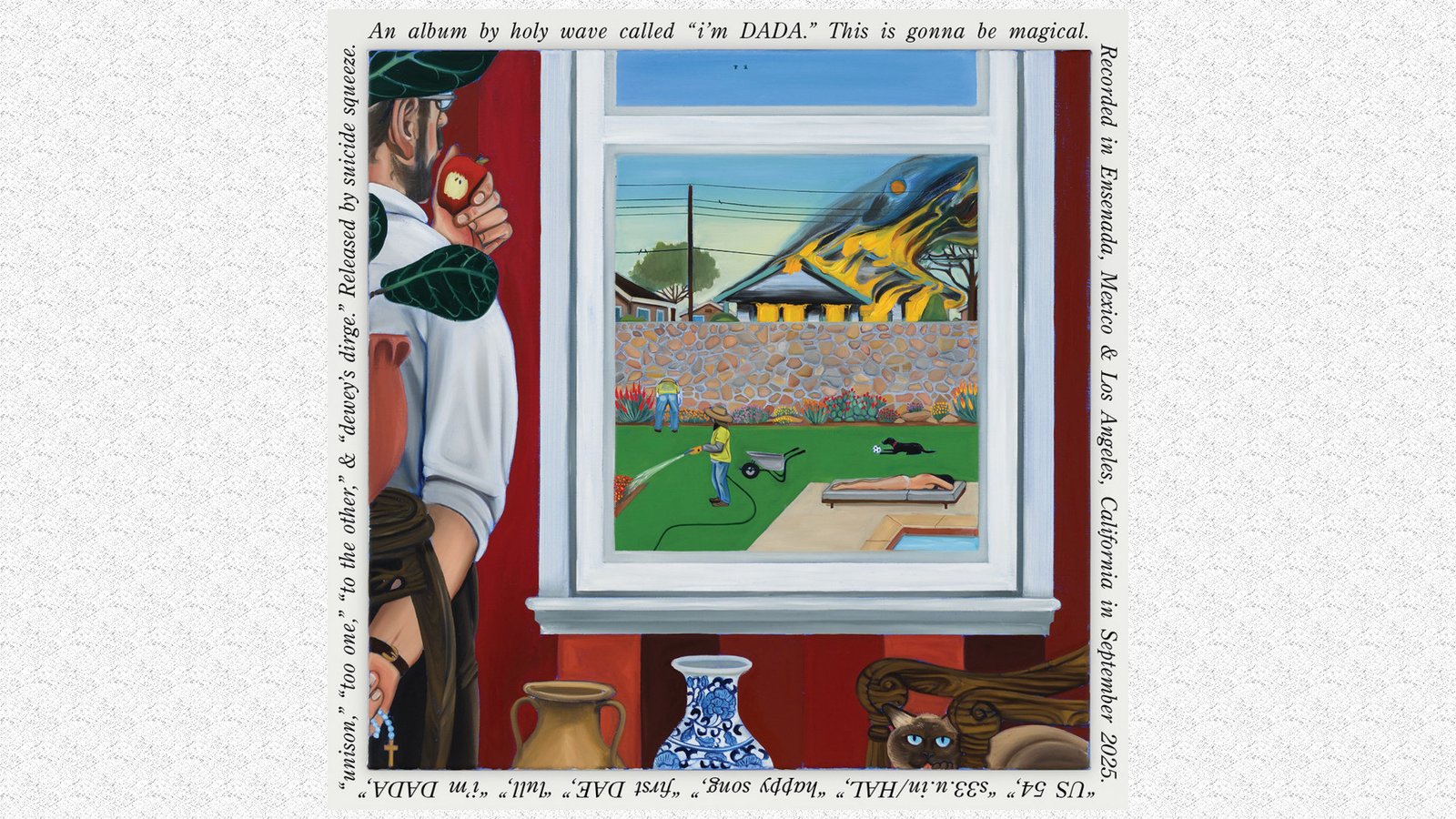
Holy Wave i’m DADA. Recorded in Ensenada, trading haze for intention. The band’s most deliberate work. Reviewed.
Genre: Psychedelic Rock, Shoegaze, Dream Pop
Holy Wave have spent over a decade on the edges of Austin’s psych-rock scene, and on i’m DADA they sound less interested in floating away and more determined to shape the fog into something physical. The album was recorded at El Derrumbe studio in Ensenada, Mexico, run by experimental duo Lorelle Meets the Obsolete. Half the band has roots in the El Paso border region, which made recording in Mexico less an escape and more a homecoming by proxy.
That geography matters more than the standard recording-location trivia usually does. El Paso sits directly against Ciudad Juárez, and musicians who grew up on that line tend to have a relationship with the border that is neither romantic nor political but simply domestic. Crossing it is a Tuesday. Recording an album on the other side of it, in a studio run by a Mexican experimental duo, positions the record inside a cultural continuity rather than across a divide, and the sound reflects that ease.
What Holy Wave’s i’m DADA Found in Ensenada
The ten tracks make more room for loops, samples, and hypnotic cyclical grooves than previous releases. Holy Wave records have always been built on repetition, but the repetition was previously atmospheric, a texture for the songs to float in. Here it appears to be structural. The emotional core, honestly, formed in conversations about fatherhood, partnership, breakups, estrangement, and the queasy acceleration of AI, which is a lot of subject matter for a band whose earlier records could be described as pleasant.
The lead single, titled with deliberate ungoogleability as “s33.u.in/HAL,” was one of the first ideas worked on and one of the last finished. Ryan Fuson described it as a prayer to the god of shortcomings, a child god the band is raising to one day be its saviour. That framing is either profound or nonsense depending on your tolerance for band-interview mysticism, but the HAL reference is doing real work. Kubrick’s computer is the original artificial intelligence that failed by trying too hard to be right, which given the record’s stated anxiety about AI acceleration is not a casual allusion.
The Mixing Decision
Joo Joo Ashworth, who mixed the album, helped crystallise the rhythmic language. Ashworth’s work with Automatic and Sasami suggests a mixing sensibility that favours clarity over wash, which for a band historically committed to wash is a meaningful choice. The result is described as propulsive, candid, and the band’s most structurally deliberate work. Whether that deliberation carries across a full album of dream-pop aesthetics and microtonal experimentation remains to be heard. Structural deliberation and psychedelic drift pull against each other, and a lot of bands have failed at holding both.
The geography matters more than recording-location trivia usually does. El Paso sits directly against Ciudad Juárez, and musicians who grew up on that line tend to have a relationship with the border that is neither romantic nor political but simply domestic. Crossing it is a Tuesday. Recording on the other side of it, in a studio run by a Mexican experimental duo, places the record inside a cultural continuity rather than across a divide, and the ease of that shows in how little the album strains for exoticism.
The album dropped on July 10 via Suicide Squeeze, a label with a twenty-five-year history of signing bands at exactly the point where they stop being a local secret. The trajectory suggests Holy Wave found something in Ensenada that Austin could not provide, which is the distance needed to recognise a sound that had been forming among them for years. Distance is underrated as a production tool. You cannot hear a room you are standing in.
Distance is underrated as a production tool. You cannot hear a room you are standing in, and Austin had been the room for over a decade.
Joo Joo Ashworth’s mixing work with Automatic and Sasami suggests a sensibility favouring clarity over wash, which for a band historically committed to wash is a meaningful appointment.nty-five-year history of signing bands at exactly the point where they stop being a local secret. The trajectory suggests Holy Wave found something in Ensenada that Austin could not provide, which is the distance needed to recognise a sound that had been forming among them for years. Distance is underrated as a production tool. You cannot hear a room you are standing in.




One Comment
Comments are closed.